English
 中文简体
Flower Petal Plates: How Shape, Rim Depth and Board Weight Affect Service
Content
- 1 What buyers usually mean by flower petal plates
- 2 Shapes, diameters and what each one is good for
- 3 Board weight, coating and the food-contact file
- 4 How petal edges change packing, stacking and freight
- 5 Print, foil and custom petal shapes
- 6 Pairing petal plates with cups, napkins and sets
- 7 MOQ, lead time and the sample check
- 8 Sustainability claims that survive an audit
Two 9-inch flower petal plates can look identical in a catalogue photo and behave completely differently on a buffet line. One carries a 400 g portion of pasta salad without its rim dipping; the other flexes at the petal notches and lets dressing run onto the table. Both may hold the same food-contact certificate. The variable is geometry, not paperwork.
Here is the short version: pick the petal count and rim depth from the food you intend to serve, then pick board weight from how the plate will be handled, and only then decide on print or foil. A five-petal plate with a 15–20 mm raised rim handles saucy catering food. An eight-petal plate with a flat 8 mm rim suits dry desserts and display tables. Reverse that order — design first, geometry later — and the usual result is a plate that photographs well and sells badly.
What buyers usually mean by flower petal plates
The phrase covers three different products, and a supplier quotation is only useful once the specification states which one you want.
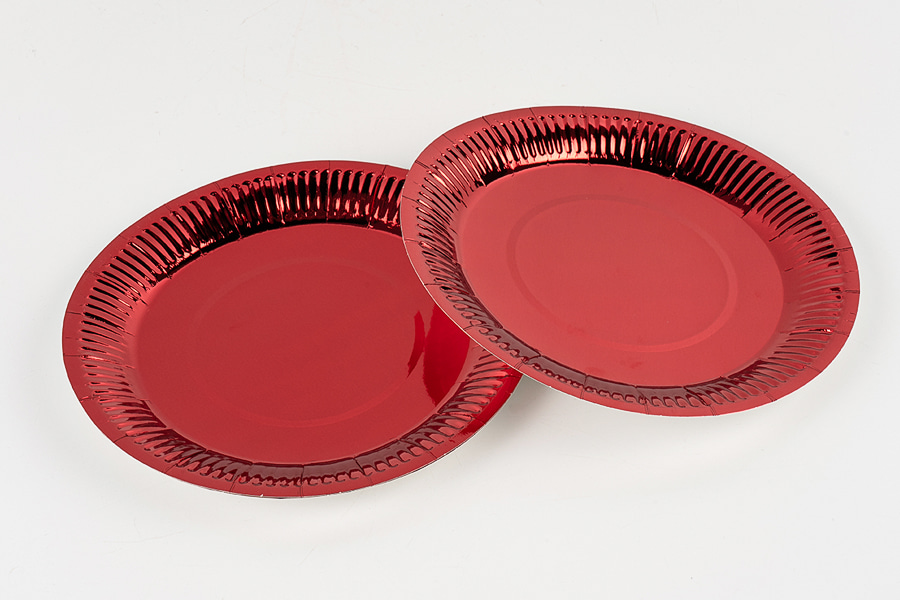
- Fully die-cut petal plates — the outline itself is a flower, with no continuous circular rim. Highly decorative, higher tooling cost, and weaker at the notch points.
- Scalloped or petal-rim round plates — a circular base with the rim cut into rounded petals. The most common catering option because it nests and stacks predictably.
- Round or square plates with a printed flower motif — the shape is standard and only the print changes. Cheapest, but not what buyers searching for petal edges expect to receive.
If a line sheet says "flower plate" without naming the construction, budget for two rounds of samples before anything is approved.
Shapes, diameters and what each one is good for
Most petal plate ranges sit between 180 mm and 260 mm. Below 180 mm the petals crowd together and the plate reads as a scallop rather than a flower; above 260 mm the rim needs heavier board to stay level under load.
| Plate style | Typical diameter | Petal count | Rim depth | Best for |
|---|---|---|---|---|
| Five-petal blossom | 180 mm / 7 in | 5 | 10–12 mm | Cake, tarts, macarons |
| Six-petal scallop | 230 mm / 9 in | 6 | 15–18 mm | Lunch buffets, salads, catering |
| Eight-petal daisy | 260 mm / 10 in | 8 | 8–10 mm flat | Sharing platters, dry snacks |
| Wave-petal plate | 200 mm / 8 in | Continuous wave | 12 mm | Canapes, cocktail service |
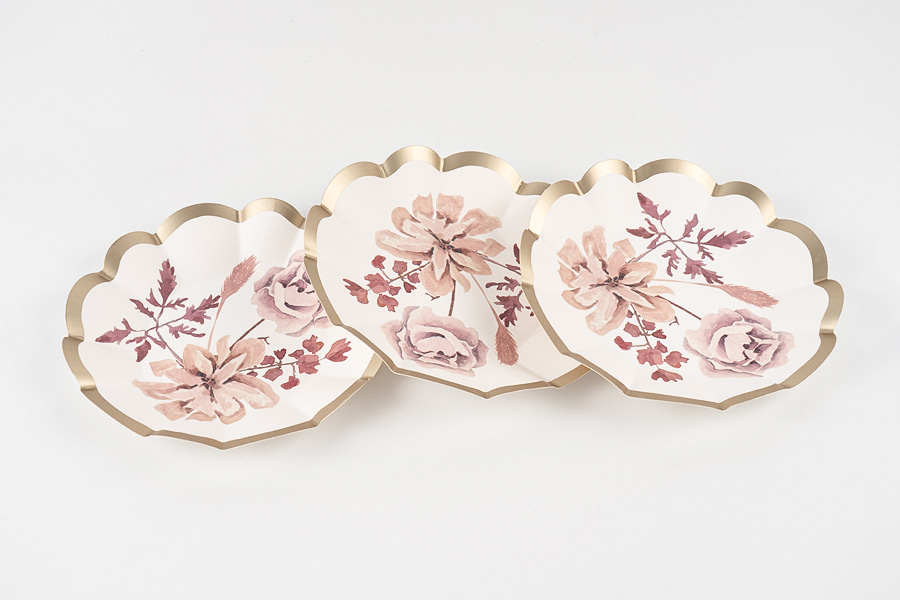 Flower-Shaped Paper Plates for Themed EventsPetal plates in 18–26 cm sizes with printed texture and oil-resistant unbleached pulp, suited to checking rim fit and load before themed table settings.View Product →
Two practical checks before you settle on a shape: place the plate on the tray or charger it will sit on, and confirm the petal tips do not overhang; then load it with the heaviest item on your menu and watch the rim for 30 minutes.
Board weight, coating and the food-contact file
Three specifications decide whether a petal plate survives real service.
- Board weight. 300–350 gsm suits dessert and single-serve plates; 350–400 gsm is the practical floor for a 230 mm plate carrying hot or wet food. Thinner board is not automatically cheaper once breakage, returns and complaint handling are counted.
- Coating. Uncoated board is fine for dry bakery items. PE coating gives the widest grease and moisture resistance; PLA is the alternative when a compostable claim is required. Ask for the coating weight in gsm and the grease resistance rating, not simply "greaseproof".
- Documentation. EU and US importers usually need FDA compliance, EU 1935/2004 conformity documentation and, where a compostable claim is made, a certificate that names the exact board and coating rather than only the finished plate.
This is where a factory audit earns its cost. Buyers who cannot travel can start with the factory and equipment overview and then request the current SGS report for the specific board grade they plan to buy, plus a sample from the production line rather than from a showroom.
How petal edges change packing, stacking and freight
A petal outline is not a circle, and that has three measurable consequences for anyone buying in container volumes.
Stack height and nesting
Petal rims interlock less predictably than round rims. A 230 mm scalloped plate often nests at 40–55 units per 10 cm of stack, against 60–70 for a flat round plate of the same diameter. That extra height is shelf space and warehouse space, so factor it into the landed cost.
Carton fill and freight cost
Because the petal silhouette wastes corner space in a square carton, a 230 mm petal plate can need a slightly larger carton than a round plate of the same size. Request the carton cube per 1,000 plates and the pallet pattern in writing; a 5–8% difference in freight volume per container is normal between two apparently similar shapes.
Notch cracking
Where two petals meet, the board bends through a tight radius. Cheap tooling leaves a visible stress line that opens in transit. Run a simple fold test on incoming lots: bend a notch 90 degrees and reject the carton if the coating crazes or the board delaminates at the crease.
Print, foil and custom petal shapes
Customisation runs in three layers, in ascending cost: surface print, foil or emboss, and a new cutting die.
- Print — offset or flexo, typically up to six spot colours. Keep any food-adjacent print away from the inner 15 mm of the plate face where grease migrates.
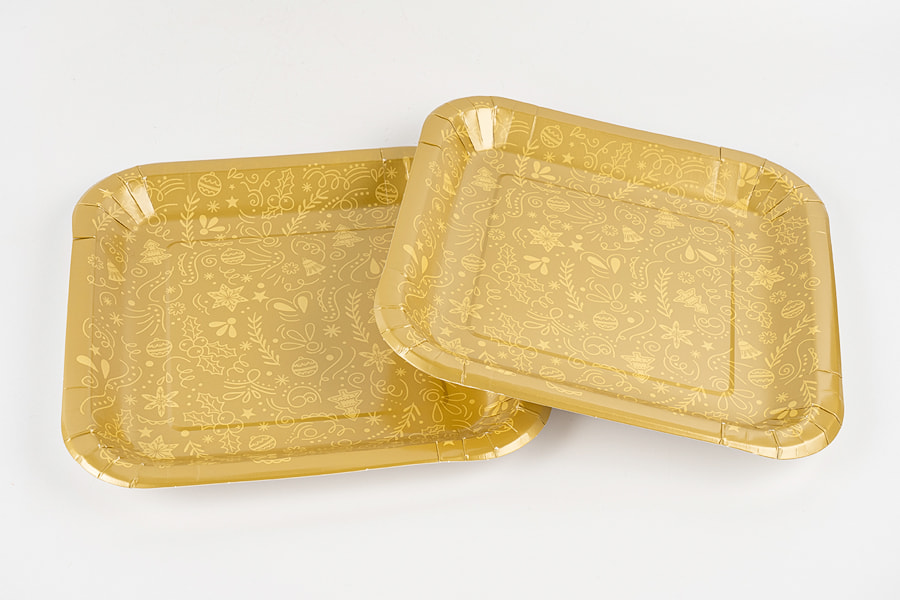
- Foil and emboss — gold or silver stamping on the rim lifts a dessert plate into gift and wedding territory, but it usually rules out a compostable claim.
- New die — a proprietary petal count or an asymmetric flower outline. Tooling is a one-off cost, so it only pays back across repeat volumes of roughly 100,000 units or a multi-season programme.
For shapes that already exist in a supplier's catalogue, customisation usually means artwork and colour rather than new tooling. Ranges built for this purpose include
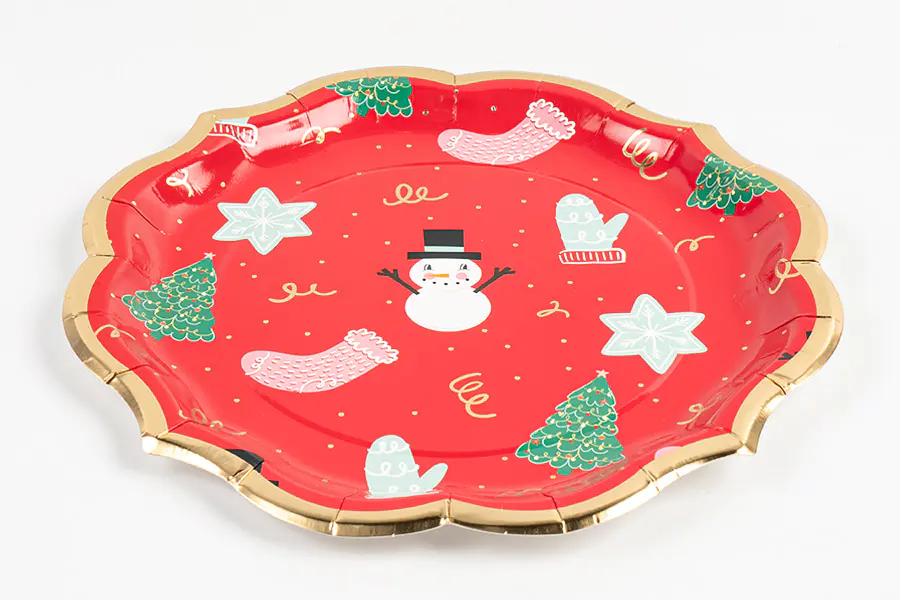 Custom-Shaped Paper Plates with Printed DesignsDiverse animal, character and geometric plate shapes with high-definition printing, multilayer options and custom artwork for events, suited to catalogue-outline customisation.View Product →
and the standard flower-shaped range, both of which accept custom prints on an existing outline.
Pairing petal plates with cups, napkins and sets
Petal plates sell best as part of a matched table story. A buyer who orders plates alone frequently returns for napkins in the same palette, and a coordinated set raises the average order value without a new die.
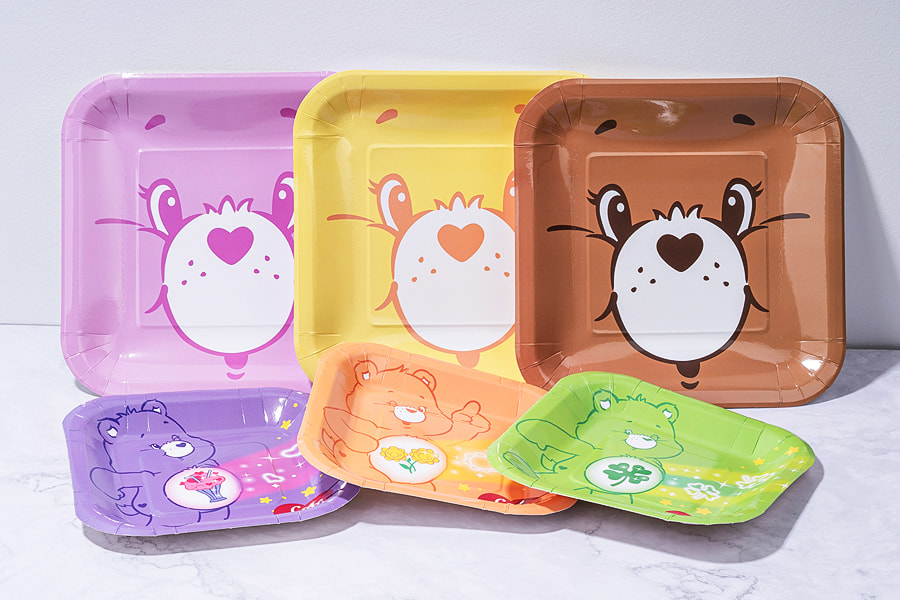
For bridal, spring and garden-party ranges, a scalloped plate pairs naturally with pressed or embossed napkins in the same shade, plus a single-wall cup in a lighter tint so the table does not read as one flat colour. For children's parties, brighter petals work with cartoon-printed square plates and a themed napkin, and the whole table can be sourced as one programme such as
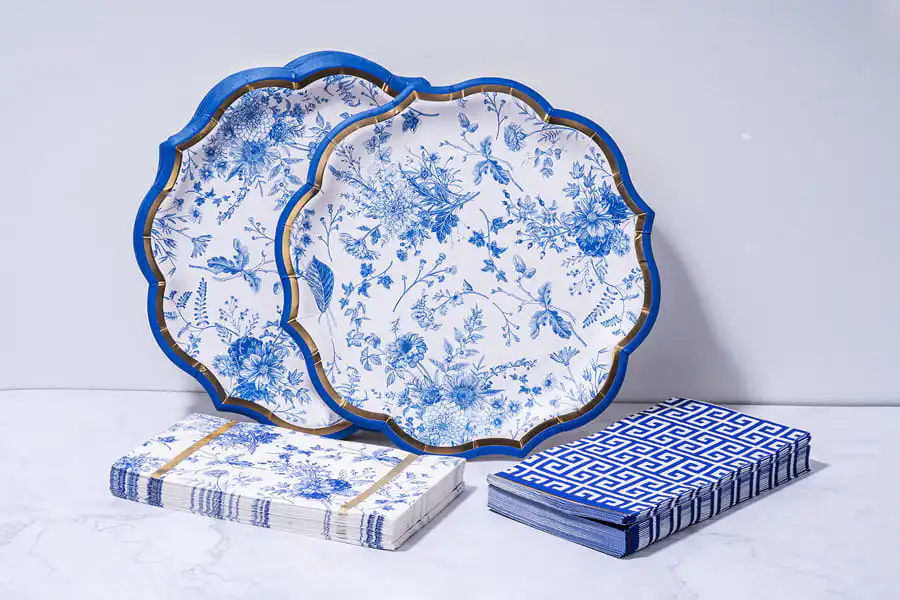 Floral Paper Napkin Sets for Themed TablesHigh-definition floral napkin sets in cocktail, lunch and dinner sizes with 2- or 3-ply options, pairing with themed plates for parties and gatherings.View Product →
or the childlike fantasy range.
The practical limit is colour consistency. Ask for a physical colour swatch of the plate, napkin and cup together before approving artwork, because print on absorbent napkin stock and print on coated plate stock will never match exactly.
MOQ, lead time and the sample check
A short checklist that prevents most first-order problems:
- Confirm the construction — die-cut flower or scalloped round — in the purchase order.
- Fix diameter and rim depth against a physical sample, never a drawing.
- State board weight in gsm and coating type in writing.
- Run a loaded test: 500 g of the actual food, 30 minutes, rim deflection under 5 mm.
- Request carton cube per 1,000 units and the pallet pattern.
- Agree the AQL level and the notch-crack rejection criteria before production starts.
For existing petal shapes, production typically runs 20–30 days after artwork approval; a new die adds 7–15 days for tooling and first-article approval. MOQs vary by print method, with plain stock generally available in smaller runs than foil-stamped or multi-colour work.
Sustainability claims that survive an audit
Decorative treatments limit end-of-life options. Foil stamping and heavy PE coating usually push a plate out of the compostable category even when the base board is certified, so the coating, the print and the finished article have to qualify together. A structured comparison of materials, certifications and supplier questions is set out in this guide to eco-friendly party plates.
Keep the wording specific. "Industrially compostable to EN 13432 with PLA coating" is defensible on a specification sheet; "eco-friendly flower plate" is not, and it tends to be the phrase that causes trouble at customs or in a retailer's compliance review.
The plate that sells is the one whose petal geometry matches the food, whose board weight matches the diameter, and whose certificates name the exact materials used. Get those three aligned and the print, the foil and the set-building become straightforward add-ons rather than corrections.