English
 中文简体
Easy Christmas Plate Designs: A Buyer's Guide to Print-Ready Holiday Paper Plates
Content
- 1 Why Easy Christmas Plate Designs Outperform Detailed Artwork
- 2 Five Christmas Plate Design Directions That Are Easy to Print
- 3 Material and Print Choices That Change the Design
- 4 Sourcing a Christmas Plate Range: What to Verify
- 5 A Practical Artwork Checklist Before You Approve a Proof
- 6 Matching Plates, Napkins, and Cups Without Overdesigning
A 7-inch paper plate offers roughly 38 square inches of surface, but only about half of it reads clearly once the plate is on a table. That is the first lesson behind easy Christmas plate designs: the designs that look effortless in a retail pack are usually the ones that respected the rim, the print registration, and the food-contact coating before anyone approved the artwork.
Start with three elements—a centered motif, one supporting border, and two flat colors—then test the design at actual size on the plate’s curved surface. Designs built this way print more cleanly, nest better, and photograph well for packaging. The rest of this guide covers which Christmas motifs survive production, how to prepare artwork, and what B2B buyers should verify before ordering a holiday range.
Why Easy Christmas Plate Designs Outperform Detailed Artwork
The strongest holiday plate ranges are not the most decorated. They are the ones that still read across a crowded table and survive a high-speed print run. On a curved paper plate, artwork stretches around the rim, shortens at the edge, and disappears under food in the center. A detailed winter village may look rich in a mock-up, but at 17 cm across it becomes a grey smear. A simple wreath or Santa medallion holds its shape.
The same logic applies to tooling. Registration between print and die-cut can move 1–2 mm on a rim. A border that relies on a 0.5 mm white gap will look uneven; a border designed with a 2 mm tolerance still looks intentional. That is why easy Christmas plate designs often use a centered motif, one repeating rim pattern, and two flat colors. The design is not less attractive—it is more controlled.
| Design approach | Print tolerance | Best use | Main risk |
|---|---|---|---|
| Centered motif | High | Retail packs, family tables | Motif looks small under food |
| Rim band with tiny icons | Medium-high | Coordinated sets, holiday menus | Pattern break at seam |
| Full-bleed photo scene | Low | Premium gifting | Muddied detail and rim distortion |
| Heavy metallic coverage | Low | Party retail | Cracking at rim; recycling confusion |
Five Christmas Plate Design Directions That Are Easy to Print
The five directions below are practical for paper plates because each one tolerates normal print and die-cut variation. They also give a buyer a coherent range rather than a single SKU.
1. Center Medallion
Place one motif in the well: a Santa face, snowflake, star, or wreath. Keep the widest point inside roughly 65–70% of the plate diameter so food does not cover the edges. Two colors—forest green and warm red—are enough. This is the lowest-risk layout for a first holiday range.
2. Rim Band with Tiny Icons
An 8–12 mm decorative band around the rim works well with repeating holly, candy canes, or small stars. The repeat tolerates a 1–2 mm shift, and a continuous band hides minor registration movement better than a single perfect border line.
3. One-Line Typography
“Merry Christmas” in a bold script or slab serif can carry the whole design. Use one typeface, one accent color, and keep strokes above 0.5 pt. The smallest word should have at least a 6 mm cap height at final plate size, otherwise it fills in during printing.
4. Die-Cut Silhouette
A tree, star, or scalloped edge makes the cut line the design. It reduces print passes and gives a strong shelf silhouette. The trade-off is tooling: die-cut shapes add lead time and cost, so confirm the die line and nesting before committing to a full range.
5. Color-In Activity Plate
Black line art on a white plate lets children color during dinner. Keep shapes large and simple, and specify a coating that resists ink and crayon transfer. For more layout examples, see this guide to creative paper plate decoration ideas.
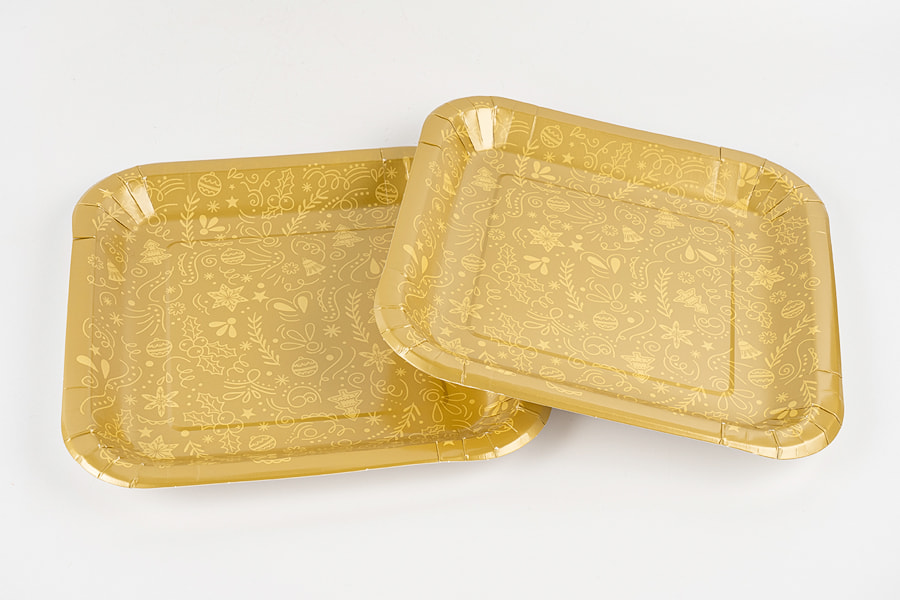 Christmas-Themed Decorative Square Paper PlatesFestive square plates with food-grade non-smudging inks and durable virgin-pulp board; suitable when holiday tableware must keep designs clear through party use.View Product →
Material and Print Choices That Change the Design
Design is only half the decision. The board, coating, and ink system decide whether the plate still looks premium after 20 minutes of party use.
- Base board and stiffness: a heavier board feels more premium and resists folding, but it can crack along a tight rim if the coating is brittle. Ask for a bend test on the actual die line.
- Coating: a grease-resistant coating protects the print and limits dark ink migration. Matte coatings support a softer, handmade look; gloss makes reds and greens pop. Check that the coating is suitable for direct food contact.
- Ink: spot colors are more predictable for brand reds, greens, and golds. CMYK is useful for photographic scenes but shifts more on uncoated board. Keep large solid areas away from the center well if the plate will hold hot or oily food.
- Rim print: rim print is visible, but it distorts. Keep critical text off the curve and repeat only simple icons or a border.
- Inside print: a printed well adds perceived value, but it is the first area to be covered. Put the brand mark or motif where it remains visible after food is served.
Sourcing a Christmas Plate Range: What to Verify
For a B2B buyer, easy design should also mean easy repeat orders. A ready-made holiday set can shorten development time, but it still needs to match your shelf plan, price point, and packing format.
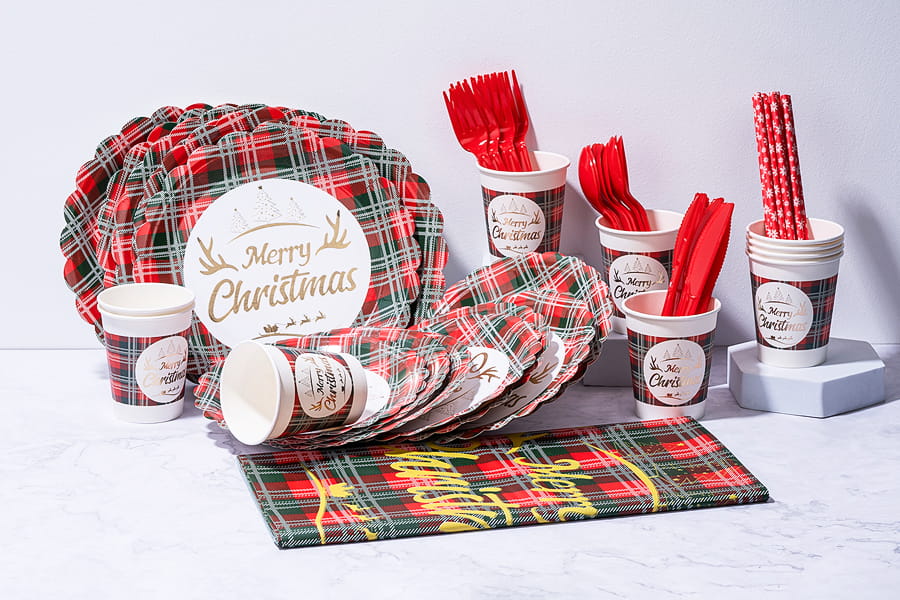 Christmas Catering Paper Tableware SetsCoordinated disposable set with cups, plates, napkins and straws in festive prints; a ready starting point for buyers matching holiday shelf plans and repeat orders.View Product →
Before you approve a Christmas plate program, verify the plate diameter, board weight, print colors, and pack count against the shelf plan. A 7-inch plate and a 9-inch plate can use the same artwork but need different spacing: what looks balanced on one looks empty on the other. Ask for a physical proof on production board, not just a digital PDF. Check how the red reads under store lighting and whether the green turns olive.
A Practical Artwork Checklist Before You Approve a Proof
Use this checklist to catch expensive mistakes before plates are printed.
- Confirm the die line and plate size. Place artwork on the actual curved surface, not a flat rectangle.
- Keep critical motifs 8–10 mm inside the rim. On a 7-inch plate, that margin is the difference between a clean border and a clipped star.
- Convert fonts to outlines or supply licensed files. A missing font can turn a script “Merry Christmas” into a default sans serif.
- Set registration tolerance at 1–2 mm and check the proof at that shift. If the design fails when moved 2 mm, simplify the border.
- Use spot colors for brand reds and greens, and request drawdowns on the production board.
- Check the coating and food-contact certificate. The print may be food-safe, but the coating and board must also comply.
- Test nesting and packing. A thick rim or heavy coating can change how plates stack and how many fit per carton.
- Approve a production sample, not a one-off hand sample. Hand samples hide print registration and die-cut variance.
Review the paper plate production and printing lines before you schedule a factory audit or place a holiday program.
Matching Plates, Napkins, and Cups Without Overdesigning
A Christmas table looks coordinated when two or three elements repeat one visual idea, not when every item carries a different scene. Use the plate as the anchor, the napkin as the quiet supporting layer, and the cup as the accent.
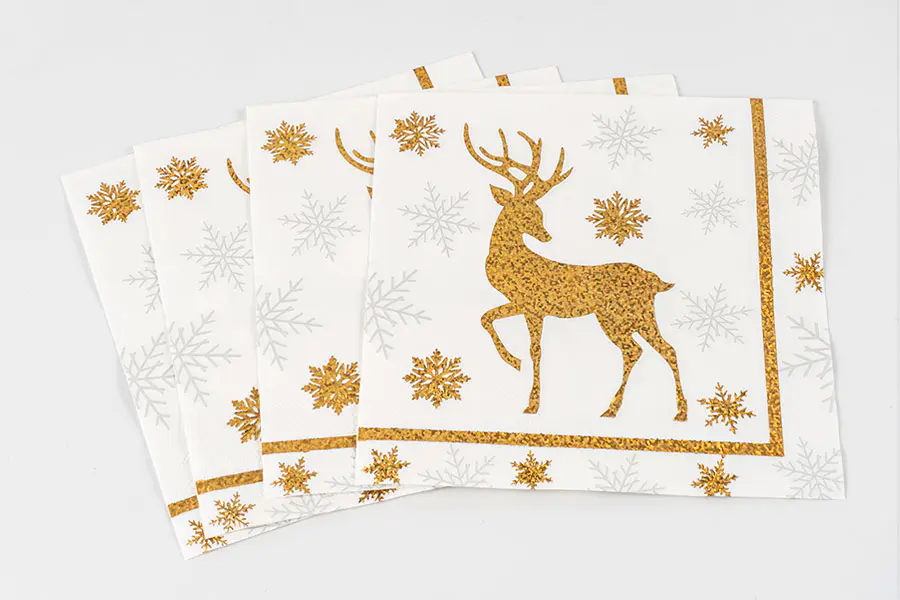 Christmas-Themed Printed Paper Napkin SeriesThick, absorbent Christmas paper napkins with customizable patterns and folds; useful as the quiet supporting layer when coordinating plates, cups and table motifs.View Product →
A useful rule: one hero motif, one secondary pattern, one solid. If the plate has a Santa medallion, the napkin can carry a thin candy-cane border or a small holly sprig; the cup can be solid green or red. If the plate is a full patterned scene, keep the napkin plain. This also reduces print risk and inventory complexity.
Easy Christmas plate designs are not a compromise. They are a production strategy: one clear motif, a border with tolerance, two predictable colors, and a coating that protects the print. Buyers who plan that way get a plate that photographs well, stacks cleanly, and still looks festive after the food is served. Before the next holiday program, review the artwork at full size, ask for a production-board proof, and keep the design simple enough to repeat across sizes. That is what makes a Christmas plate range easy—for the printer, the buyer, and the person setting the table.