English
 中文简体
Graduation Paper Goods Sourcing Guide: Plates, Cups, Napkins and Custom Sets
Content
- 1 What a Graduation Paper Goods Order Usually Contains
- 2 Color Matching Is Where Graduation Orders Slip
- 3 Shapes and Foil Details That Still Read in Photographs
- 4 Sets or Individual SKUs? Structuring the Purchase Order
- 5 Compliance Documents to Collect Before the First Shipment
- 6 MOQ, Lead Times and the Commencement Calendar
- 7 A Buyer Checklist Before the PO Goes Out
Two dates decide whether a graduation paper goods program ships on time: the ceremony date and the day the buyer signs off on the printed color proof. Everything between those two points is arithmetic — plate counts, napkin ply, carton configuration, container loading.
Graduation is one of the few disposable-tableware categories where print matters more than paper. Buyers are matching school colors, orienting a crest or mortarboard graphic the right way up, and keeping plate, cup, napkin and cutlery pouch consistent under gymnasium lighting and in phone photos posted within minutes of the ceremony. Specify the order like custom printed packaging rather than commodity plates, and most of the risk disappears before production starts.
What a Graduation Paper Goods Order Usually Contains
Commencement work is normally built from six to eight SKUs rather than one set, because service style varies across a single campus: a buffet reception in the hall, a plated dinner for faculty, a stand-up toast in the lobby. A reference build for a reception-style event looks like this.
| Item | Common specification | Service role | Qty per 100 guests |
|---|---|---|---|
| Dinner plate | 9–10.25 in, coated board | Buffet mains, cake slices | 200 |
| Dessert plate | 7 in, matched to dinner print | Cake, fruit, pastries | 200 |
| Cold cup | 9–12 oz, single or double wall | Water, soft drinks, iced tea | 200 |
| Hot cup | 8 oz, double wall | Coffee service | 80 |
| Beverage napkin | 2-ply, 1/4 fold, embossed | Glasses, hand service | 300 |
| Luncheon napkin | 2-ply, 1/8 fold | Buffet line, seating | 200 |
| Cutlery pouch | Printed kraft or white board | Fork, knife, napkin kit | 100 |
| Paper bag | Printed, flat handle | Gift and gown handouts | 100 |
Two adjustments pay for themselves. On a buffet, shift volume from dinner plates to dessert plates, because guests take a second small plate far more readily than a second large one. And if the venue photographs the head table, upgrade napkins before plates: napkins cover more visible area per dollar than any other printed item on the table. For sizing logic across event formats, our paper plate guide for every event size sets out the standard diameters and where each one earns its place.
Color Matching Is Where Graduation Orders Slip
School colors reach the supplier in three incompatible formats: a Pantone chip from a brand guideline, a hex value lifted from a website, and a photograph of a banner taken in poor light. Those three describe three different colors. Ask the buyer to confirm a Pantone number together with the reference book, coated or uncoated, and mail a physical swatch of the gown fabric, pennant or diploma folder.
Then put tolerance in writing. A practical target for printed rims and napkin borders is a color difference of two to three Delta E units against the approved swatch, measured under daylight-balanced lighting; below that threshold most observers read two production runs as the same color. Above it, side-by-side photos of the head table start to look mismatched.
Four print decisions that change the final color
- Spot ink versus a CMYK build. A deep navy or burgundy mixed from four process inks drifts under different light sources; a spot ink holds its position.
- Base board shade. The same ink printed on uncoated kraft and coated white board can land two or three Pantone steps apart.
- Metallic gold and silver. Foil or metallized film reads as metal; gold ink reads as olive-brown at small sizes and low coverage.
- Ink coverage on the rim. A 5 mm rim band and a full-wrap print carry different ink loads and dry at different rates, which affects rub resistance.
Approve a digital proof for artwork and a press proof for color. Keep the signed press sheet in the buyer's file: it is the only reliable reference when the same design is reordered for the next commencement season.
Shapes and Foil Details That Still Read in Photographs
Decoration should be judged the way guests actually see the table: from standing height, at arm's length, in mixed indoor light. Fine 0.25 pt linework inside a crest disappears at that distance, while a solid silhouette or a bold single-weight mark survives.
Where a custom die earns its tooling cost
A mortarboard or shield silhouette, a scalloped edge, a tassel-shaped napkin — these read instantly in photos because the outline carries the message before anyone reads the print. A custom shape needs a cutting die, so it is worth the setup only when the design repeats: a university that orders every year, or a distributor serving a cluster of schools in the same conference.
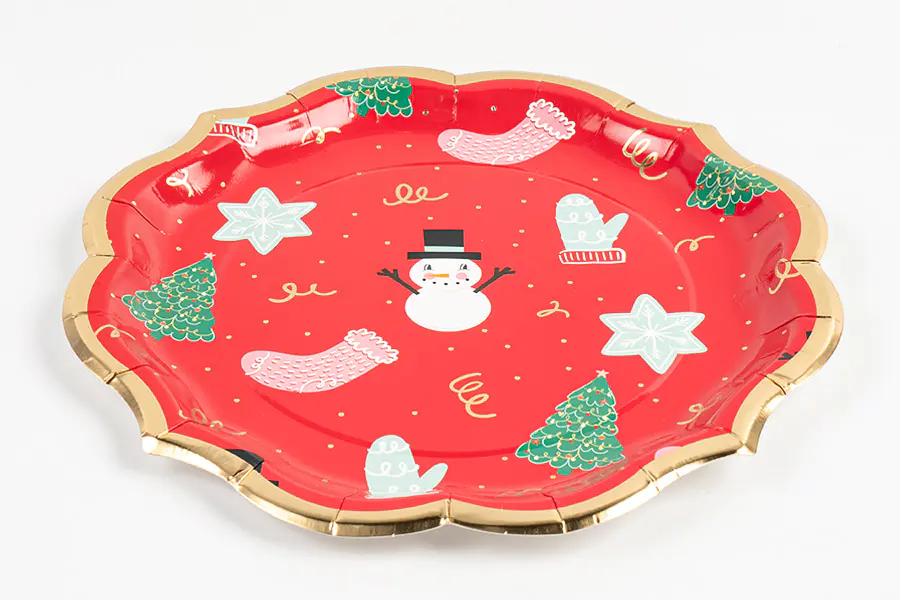 Custom-Shaped Paper Plates for Repeat OrdersCustom disposable paper plates in bespoke shapes, suited to repeat school or distributor orders where retaining the die avoids setup charges on reorders.View Product →
Keep the die number on file. Second-year reorders that reuse the existing tooling avoid both the setup charge and the registration drift that comes with a rebuilt die.
Foil and embossing for the toast
Gold-stamped cups are the cheapest upgrade that makes a reception table look deliberate: a single foil band around a 9 oz cup costs far less than a laminated wrap and photographs with a clear edge. Embossed napkins work the same way — texture without extra ink, and a surface that catches light on a white tablecloth.
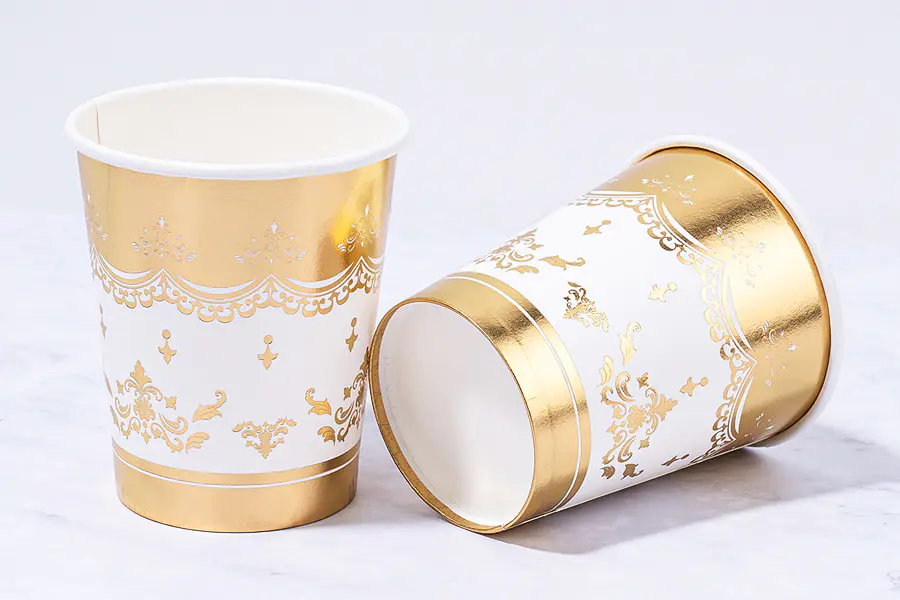 Gold-Stamped Single-Layer Paper Cups for ReceptionsSingle-layer cups with high-gloss hot-stamped logos, a cost-effective upgrade for reception tables; best foil contrast on light backgrounds.View Product →
One caution on foil: it does not print over dark saturated backgrounds reliably at small sizes. Pair it with white or light bases, and let the school color sit in the ink layer instead.
Sets or Individual SKUs? Structuring the Purchase Order
Both structures sell, but they carry different inventory risk, and the right choice depends on who is holding the stock.
- A coordinated set ships as one carton configuration with matched colors and one artwork approval. It simplifies quoting and cuts the number of purchase order lines, but it locks the buyer into a fixed mix.
- Individual SKUs let a distributor top up fast-moving items — beverage napkins and dessert plates — without reordering slow lines. They cost more in artwork and proofing time.
- Hybrid approach: one printed set for the reception plus bulk solid-color plates for the staff room and back-of-house.
Where the table is styled rather than simply stocked, a curated set is usually the cleaner buy, because the color relationships were resolved at the design stage instead of across three separate proof rounds.
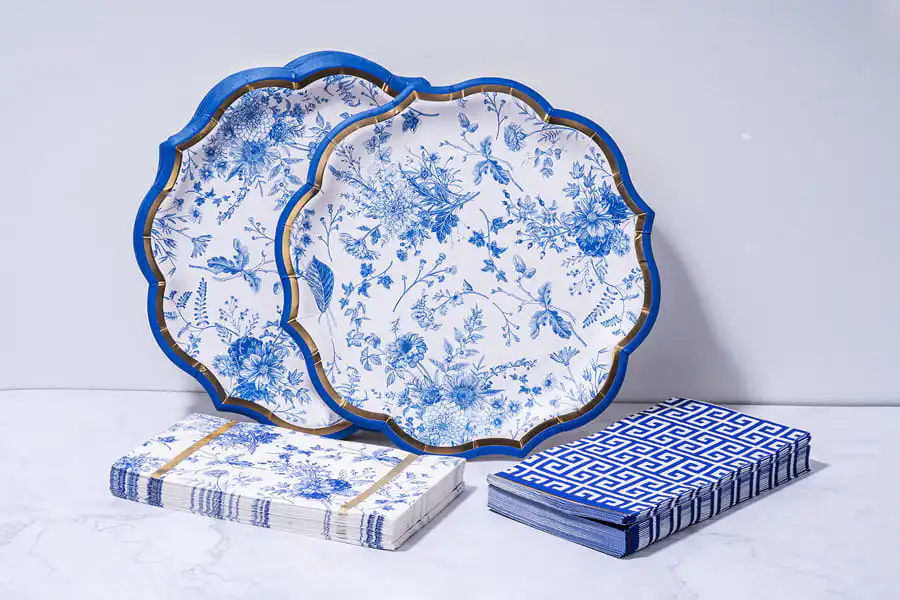 Elegant Floral Themed Paper Napkin SetsCurated floral napkin sets with coordinated patterns and food-grade inks, a cleaner choice when table styling is resolved at design stage.View Product →
Whatever the structure, specify carton counts against the destination: foodservice case packs, retail-ready shelf packs with barcodes, or loose-packed bulk for event labor. Pallet configuration and container fill follow from that decision, not the other way round.
Compliance Documents to Collect Before the First Shipment
Paper tableware contacts food directly, so the paperwork carries as much weight as the print. Depending on the destination market, a buyer should expect the following before the first container leaves.
- FDA 21 CFR 176.170 and 178.3800 compliance statements for US-bound paper and board, including the coating layer.
- EU 1935/2004 declaration of compliance, plus 10/2011 where a plastic coating or lining is used.
- GB 4806 series declarations for the China market and LFGB test reports for Germany.
- Third-party migration test reports showing the report number, the testing laboratory and the date.
- Grease resistance results and a hot-fill note if plates will carry fried food or sauce-heavy catering.
- FSC chain-of-custody or recycled-content statements when the buyer markets the event as low-waste.
Ask for the report date rather than a certificate image — buyer compliance teams reject documents older than twelve months more often than suppliers expect. Our factory and quality control overview sets out the inspection steps, from thickness and stiffness checks to seal integrity, that sit behind those documents.
MOQ, Lead Times and the Commencement Calendar
Custom printed graduation goods commonly carry a minimum of 3,000–5,000 pieces per design per SKU, because each run consumes press setup and a die-cut setup. Stock designs and solid colors move in smaller quantities and are the usual fallback when a date is fixed and artwork is late.
Commencement dates cluster in May and June, with a smaller winter round in November and December. Working backwards from a mid-May ceremony:
| Timing | Milestone | What the buyer supplies |
|---|---|---|
| 6 months out | Brief and artwork | Vector logo, Pantone references, size list |
| 5 months out | Digital proof | Consolidated comments in one round |
| 4 months out | Press proof and PO | Signed proof, deposit, shipping documents |
| 3 months out | Production slot booked | Carton and pallet specification |
| 6–8 weeks out | Inspection and packing | Label and barcode files |
| 4–5 weeks out | Shipment | Booking confirmation and consignee details |
The buffer in the final weeks is not slack. It absorbs a late proof revision, a port delay or a venue change of date — three events that occur in most commencement cycles. A fixed ceremony date should drive the proof schedule, not the product list.
A Buyer Checklist Before the PO Goes Out
- Confirm Pantone references with the book code and a physical swatch.
- Collect vector artwork and check minimum line weight and crest clear space.
- Decide spot ink versus CMYK, and foil versus metallic ink.
- Verify plate diameters against the venue's trays, bins and photography setup.
- Confirm ply, fold and embossing for each napkin size in the order.
- Match carton counts to the case pack the customer will actually sell or open.
- Request test reports with dates, not scanned certificate images.
- Book the production slot before artwork is final if the date cannot move.
Graduation orders rarely fail on design. They fail on a color approved by email, a plate that does not fit the venue's tray, or a proof signed three weeks after production needed to begin.
Keep three files after every shipment: the signed press sheet, the cutting die number and the carton specification. Those three turn next season into a reorder instead of a new project — and the margin in this category sits in the reorder.